
Industrial Process
With high-viscosity media, selection starts by sizing the suction side correctly. It is the inlet, not the outlet, that sets the capacity of the line.
The process
Typical duties are feeding the production line from storage, emptying mixers, filling and drum-to-drum transfer.
With media such as bitumen and grease, both the line and the pump are heat-traced. As temperature falls, viscosity rises quickly.
Fluid characteristics
- Viscosity depends strongly on temperature. Between 20 °C and 60 °C the difference can be several times over.
- Filler compounds contain abrasive mineral content.
- Most of these media have low vapour pressure, so the suction side is relatively resistant to cavitation.
- On continuous lines the pump runs around the clock.
Where it gets difficult
- An undersized suction cross-section stops the pump filling at high viscosity and the flow rate drops.
- Abrasive fillers open the clearance between rotor and casing quickly.
- On a cold start the torque demand rises far above normal operation.
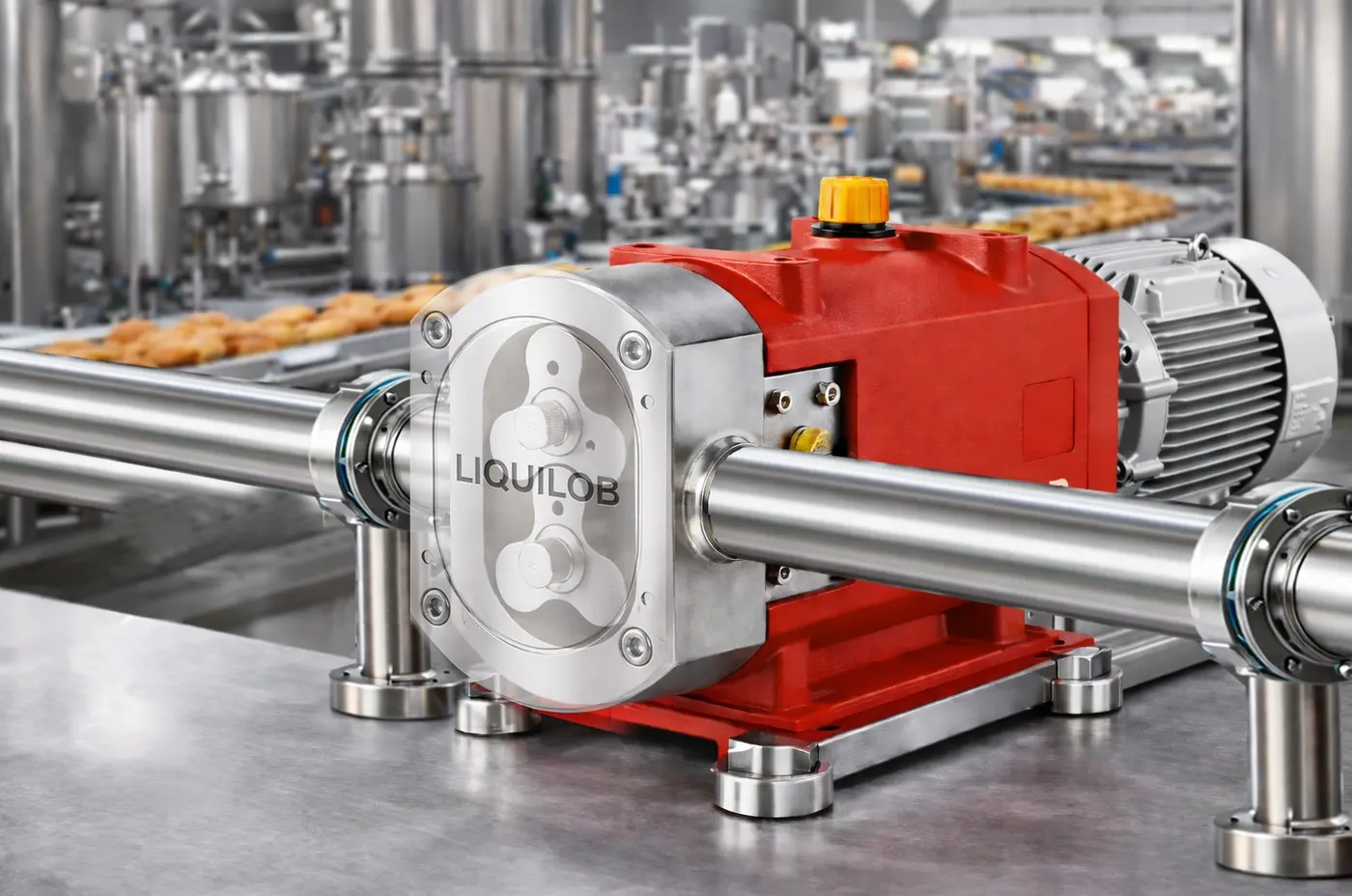
The Liquilob approach
For high-viscosity media the pump is selected with a larger frame at low speed. That gives the suction side time to fill and keeps volumetric efficiency high.
A heating jacket can be applied to the casing and cover. Cold-start torque is treated as a separate criterion in the drive selection.
For abrasive fillers, hardened rotor surfaces and replaceable wear plates are specified.
Materials and hygiene
Let us determine the right pump for your application together.
Share your fluid characteristics and operating conditions, and our engineering team will help you arrive at the right Liquilob configuration.