Pharmaceutical & Cosmetics
On pharmaceutical and cosmetics lines cleaning has to be verifiable. The pump geometry is chosen so that no volume is left where the cleaning procedure cannot reach.
The process
Between the homogeniser outlet and the filling line the emulsion has to stay stable. Excess shear changes the droplet size distribution and shortens shelf life.
Product changeovers are frequent, so strip-down and cleaning time sets the effective production capacity.
Fluid characteristics
- Most products are thixotropic or pseudoplastic, so viscosity at the pump inlet differs from the measured value.
- Air entrainment is not acceptable. Foam disturbs both fill volume and appearance.
- Cross-contamination risk is limited by geometry and surface quality.
- Surface roughness and weld quality form part of the validation file.
Where it gets difficult
- High-shear pumps thin the emulsion and the product moves outside specification.
- Complex internal geometry makes cleaning validation harder and increases the documentation load.
- With high-viscosity pastes the suction side is starved.
The Liquilob approach
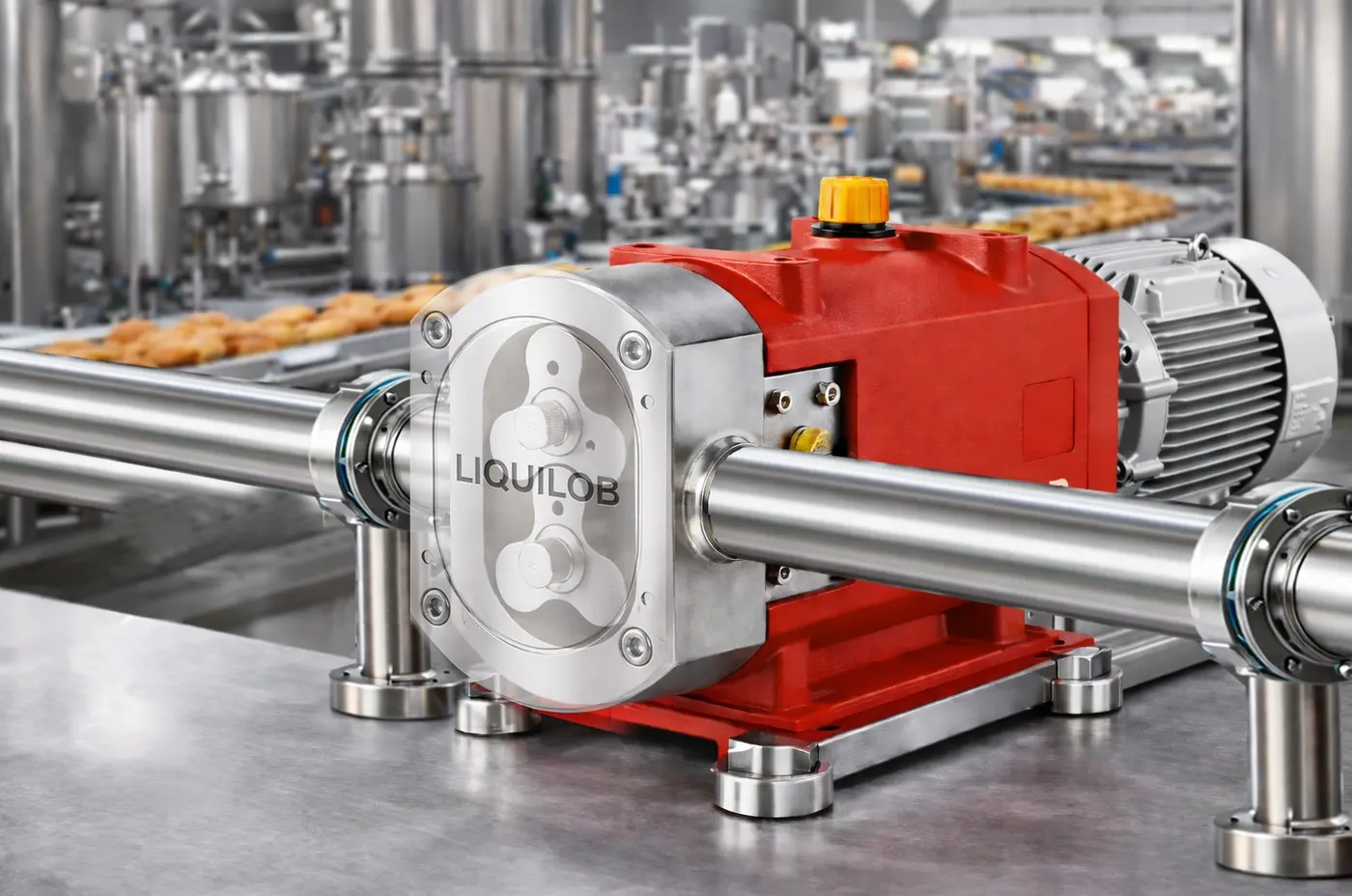
In the hygienic configuration the internal geometry is simplified and dead volume and sharp transitions are limited. A cartridge seal reduces the scope for assembly error during strip-down.
Running at low speed limits the shear energy applied to the emulsion. Flow demand is met by choosing the frame size rather than by raising the speed.
With high-viscosity pastes the suction port is enlarged or a fed configuration is used.
Materials and hygiene
Let us determine the right pump for your application together.
Share your fluid characteristics and operating conditions, and our engineering team will help you arrive at the right Liquilob configuration.