
Food & Beverage
On food lines the pump choice is usually less about flow rate and more about protecting the product. Particle integrity, air entrainment and cleanability are assessed together.
The process
A typical line uses the pump at three points: feeding from the mixing tank to an intermediate vessel, building pressure ahead of a pasteuriser or heat exchanger, and metering into the filling machine.
Each point defines a different requirement. Emptying a tank calls for dry suction, the heat exchanger needs stable pressure, and filling needs a repeatable flow that tracks shaft speed.
Fluid characteristics
- Viscosity changes considerably with product temperature. The cold start value can be a multiple of the running value.
- Most products carry delicate solids: fruit pieces, spice grains, diced vegetables.
- Products are shear sensitive. At high shaft speeds emulsions separate and body is lost.
- The line is washed with CIP solution at the end of a run, and the pump operates in that regime too.
Where it gets difficult
- Centrifugal pumps grind particles at high speed and lose efficiency as viscosity rises.
- Product left in dead volumes carries flavour and colour into the next batch.
- Pulsation on a filling line degrades fill volume tolerance directly.
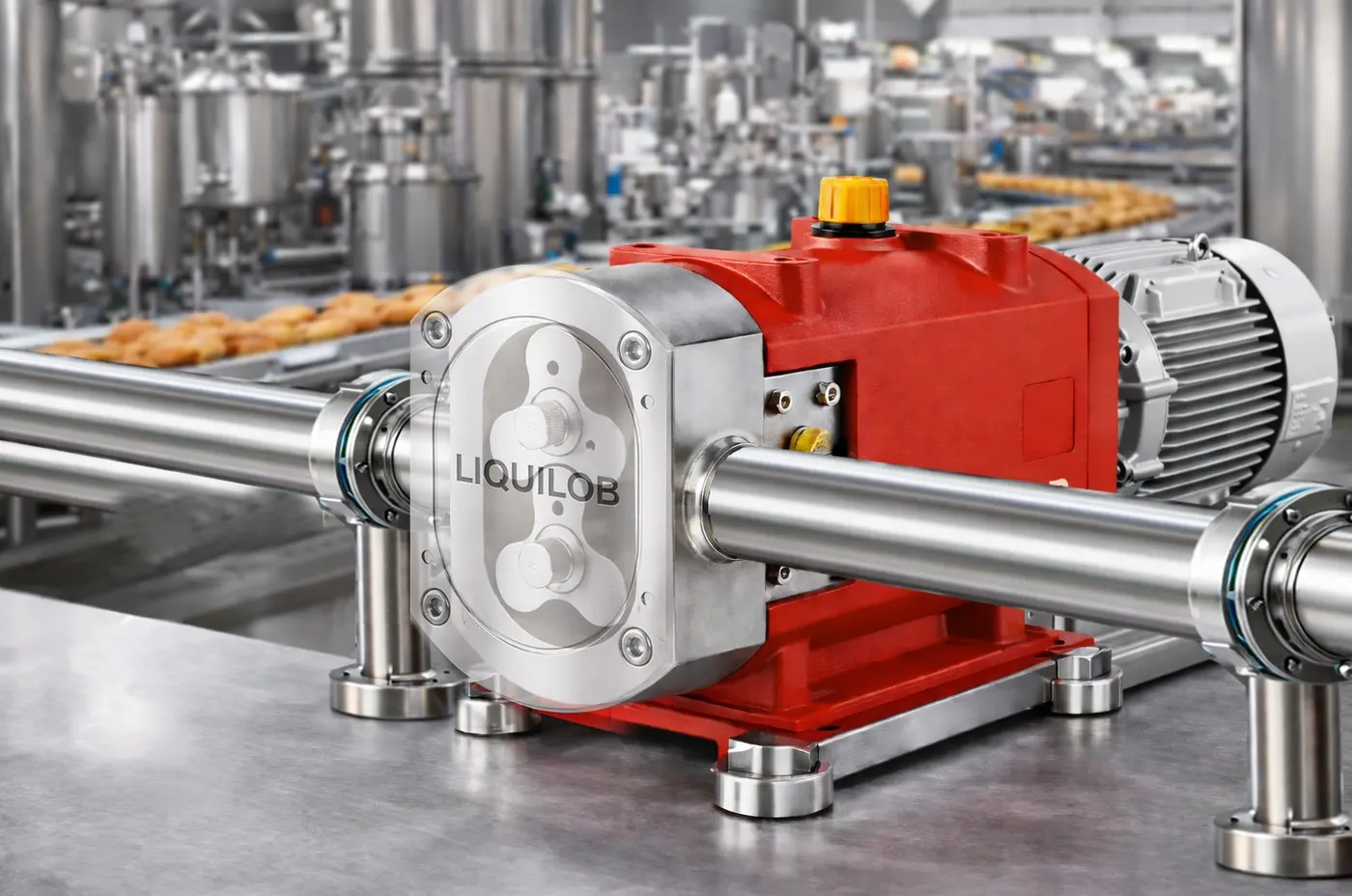
The Liquilob approach
Liquilob lobe pumps run at low speed and their wide flow passages carry particles rather than crush them. Because flow tracks shaft speed, a filling line can control volume directly from the frequency drive.
Where pulsation is critical, a tri-lobe rotor is specified. Where particle size is large, as in chunky sauces, a single-wing rotor is the better choice.
The casing geometry limits dead volume and the rotors come out through the front cover, which shortens changeover between batches.
Materials and hygiene
Let us determine the right pump for your application together.
Share your fluid characteristics and operating conditions, and our engineering team will help you arrive at the right Liquilob configuration.